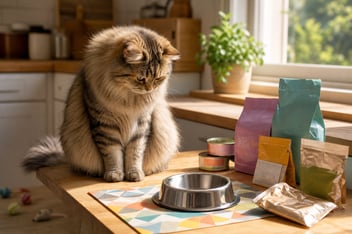
The proof is in the bowl: how dog owners really judge the food they buy
Britain's dog population has jumped since 2021, and "natural" dog food brands are changing hands across Europe. Yet in owners' own reviews, the recipe on the pack rarely wins the argument by itself. What settles it is what the dog shows: an empty bowl, firm stools, a shiny coat. With wet food, it is also what the owner sees when the tin is opened.
The UK now has 15.5 million pet dogs, up from 12.5 million in 2021, and 41% of households own one (UK Pet Food, 31 March 2026). In July 2026, Assisi Pet Care completed its acquisition of Forthglade, a British maker of "minimally processed" dog food (IK Partners, 20 July 2026). Two years earlier, General Mills had completed its purchase of Edgard & Cooper, a natural, premium brand sold in 13 European markets (General Mills, 30 April 2024). Trade press describes a wider European consolidation cycle (GlobalPETS, 16 September 2026).
These deals put a value on a promise: real ingredients, a recipe you can read. We wanted to know what owners actually hold on to when they describe their experience. In the UK, Germany and France, the answer is the same: they do not trust the label, they trust their dog.
- The dog validates, not the label. In every market studied, palatability is the first reason owners give for choosing a food. Ingredients come far behind.
- The dominant story is relief. In the UK, Germany and France, the leading theme in reviews is "the bowl that finally works", after trials, refusals or upset stomachs.
- The proof is visible. An empty bowl, firm stools, a shiny coat, energy: this is how owners decide a recipe works. In the UK, visible health ranks second only to taste.
- Wet food is also judged by eye. Visible meat is mentioned as often as taste or digestion. Jelly, fat and water are its main failings, and a changed recipe is noticed first in the tin.
- Wet food tops up more than it replaces. Mixing it with kibble is its leading use in France and Germany, and a major one in the UK.
- For a "natural" brand, the issue is proof. Its promise convinces when the dog confirms it; on its own, it stays in the background.
1. In the UK, the dog is the judge
Ask British owners why they buy a dog food and the first answer is taste. Palatability leads the reasons for choosing a food. What comes second is distinctively British: visible health, meaning a glossy coat, energy and a stable weight. Ingredients account for roughly one mention in ten.
The most common story in UK reviews is a search that ends well. Owners describe trying several foods, a dog that leaves its bowl or reacts badly, and then the recipe that works. "The bowl that finally works" is the leading theme in British reviews, as it is in Germany and France.
Three markets, one rule
| UK | Germany | France | |
|---|---|---|---|
| First reason for choosing | Palatability | Palatability, level with digestion | Palatability |
| Second reason | Visible health: coat, energy, weight | — | Digestive tolerance |
| Leading theme in reviews | "The bowl that finally works" | "The bowl that finally works" | "The bowl that finally works" |
| Local accent | The loyal, organised multi-dog household | Solving a digestive problem, partly driven by foods for sensitive dogs | Fit for this dog: age, size, neutered status |
Rankings are set within each market; levels are not compared across markets.
The proofs owners rely on
| Proof | What the owner sees | When |
|---|---|---|
| The empty bowl | The dog eats quickly, finishes its portion, waits for its meal | From the first days |
| What comes out | Firm, regular stools, no diarrhoea or wind | During the switch |
| Coat and energy | A shiny coat, a lively dog, a steady weight | Over the weeks |
Composition still matters. It helps owners decide what to try and reassures them when the result is there. But it does not overrule the dog.
“my dog like this food, and she never leave any in her bowl, but when i checked ingredients list i must say that they could do better”
Review of Bakers Adult (dry), 3/5
The reverse holds too: a pricier food is justified by what the dog shows.
“[…] were amazed she was noticably more active and her poo was always perfect […] OK its more expensive but we wont change because of our dogs consistently good health”
Review of James Wellbeloved Turkey & Rice (dry), 5/5
For brands: the most represented UK owner is the loyal, organised multi-dog household that buys large bags or by subscription. For these owners, a food that works is a food they stop thinking about.
2. Wet food: owners also look in the tin
With wet food, a second proof joins the dog's verdict: what the owner sees when the tin, tray or pouch is opened. Across the European wet foods we analysed, visible meat (recognisable pieces, a high meat content) is mentioned as often as taste or digestion. In dry food reviews, composition sits far behind taste, digestion and coat.
« La viande de bœuf a une bonne consistance, ça change de tous ces aliments qui coulent littéralement hors de la boîte et qui semblent principalement constitués de gelée ou d'eau ! »
("The beef has a good consistency, a change from all those foods that literally pour out of the tin and seem to be mostly jelly or water!")
Review of Rocco Classic (wet), 4/5. Translated from French.
The flip side is immediate. The main complaints about wet food concern what can be seen and smelt: too much jelly, fat or liquid, a strong odour, a texture that varies from one batch to the next. Some owners feel they are "paying for water".
Dry and wet: two kinds of proof
| Dry food | Wet food | |
|---|---|---|
| What proves it | The dog: taste, digestion, coat, over time | The dog, plus what is visible in the tin: meat, texture |
| Typical complaints | Refusal, digestive upset | Too much jelly, fat or water; odour; uneven batches |
| Role in the bowl | The base meal | Often a topper for kibble (leading use in France and Germany) |
| Risk to watch | Intolerance | A changed recipe, spotted by eye first |
In Britain, wet food reviews often tell a gut story, with a tin that settles a sensitive stomach:
“After our elderly JRT had a bout of Colitis most of her usual foods were upsetting her stomach, a friend suggested Chappie and what a difference, a happier Dog, solid poo's and she loves this food.”
Review of Chappie Dog Favourites (wet), 5/5
Wet food is mostly a topper. Mixing it with kibble is its leading use in France and Germany, and a major one in the UK. That role carries a doubt: is wet food enough on its own?
« Nous le mélangeons avec du poulet et des croquettes. A l'achat il fait partie des moins chers. Après je ne suis pas certaine que ce soit totalement équilibré, c'est pour cette raison que nous complétons. »
("We mix it with chicken and kibble. It's one of the cheapest when you buy it. That said, I'm not sure it's fully balanced, which is why we add to it.")
Review of Pedigree Vital Protection in sauce (wet, Carrefour France), 4/5. Translated from French.
Pet Care – Dog Food – Europe
Pet care · Europe · 70,000+ signals
Explore how dog owners judge dry and wet food: palatability, digestion, coat, visible meat and texture. Compare markets, formats and brands, and follow how each recipe or reformulation is received.
3. Germany: tolerance first, and the cost of changing a recipe
In Germany, digestive tolerance weighs as much as taste. In German reviews, digestion is mentioned as often as palatability, and the leading owner profile is the one solving a digestive or allergy problem. This result is partly driven by foods for sensitive dogs, which are prominent among the German products we analysed. It describes a segment more than a national trait.
Germany also shows wet food's particular risk. When a trusted recipe changes, visible meat is the first thing owners notice. This "recipe that changed" story weighs far more in wet food reviews than in dry food reviews, in Germany and in the UK.
„Rezeptur verändert - wieso ohne Warnung? […] Keine Fleischstücke mehr. […] Der Hund mag es nicht.“
("Recipe changed, why without warning? […] No more meat pieces. […] The dog doesn't like it.")
Review of Rocco Classic (wet), 1/5. Translated from German.
„Keine Fleischstücke mehr zu finden, das Ganze wirkt minderwertig.“
("No meat pieces to be found any more, the whole thing looks inferior.")
Review of Rinti Kennerfleisch (wet), 1/5. Translated from German.
The context gives these reactions weight. In 2025, German sales of both wet and dry dog food declined slightly in value, while dog snacks grew, in the retail channels tracked by the industry associations IVH and ZZF (IVH/ZZF, 27 April 2026). In a main-meal market that is not growing, a staple product that disappoints its regular buyers may have little room for error.
4. France: same rule, an even stronger taste test
French owners apply the same rule, with taste even more dominant: palatability accounts for half the mentions explaining why a food is chosen, and ingredients for fewer than one in ten. French reviews also insist more than others on fit: the right recipe for this dog's age, size or neutered status.
« Après avoir essayé en 2 ans, 4 marques de croquettes sans céréales pour mon berger, j'ai enfin trouvé des croquettes qu'il aime et qu'il supporte au niveau intestinal […] Première fois qu'il finit tous les jours ses rations. Plus besoins de rendre son repas plus appètent en rajoutant de la patté, de l'eau chaude ou du gruyère. Enfin !!! »
("After trying 4 brands of grain-free kibble over 2 years for my shepherd, I finally found kibble he likes and that agrees with his gut […] The first time he finishes his portions every day. No more need to make his meal tastier by adding wet food, hot water or cheese. Finally!!!")
Review of Josera JosiDog (dry), 5/5. Translated from French.
Retailer brands are prominent among the French wet foods we analysed. Grocery retail is the leading place to buy dog food in France, cited for 51% of purchases ahead of pet shops (34%) and online (28%), according to the French pet food manufacturers' association FACCO (FACCO 2026 activity report; several answers possible). On the shelf, the tin and its promise have to convince on their own.
5. What this means for a "natural" promise
Recent deals put a value on brands built around their recipe. Owners' reviews suggest that this value does not rest on the promise alone, but on the proof it produces in the dog and in the bowl. A "natural" recipe the dog snubs does not convince; an ordinary one it wolfs down and digests well gets bought again. This is not a measure of sales or loyalty, but it is what owners themselves say.
| Team | Questions to ask |
|---|---|
| Marketing and Brand | Which visible proof carries the promise: the empty bowl, the stools, the coat? Is it shown, or only the ingredient list? In wet food, does the pack let owners see what is inside, and does the texture live up to the picture? Are owners' words ("finally", "clears his bowl", "agrees with her") the brand's words? |
| Strategy, Category and Portfolio | What role should wet food play in the range: complete meal, kibble topper, or both, with a clear message on balance? Is a reformulation of a trusted product tested against what owners actually check, visible meat and texture first? In an acquisition, what makes a "natural" brand valuable: its promise, or the proof its customers see? |
These questions apply beyond the brands in our analysis: they concern how the category is judged, not how any one brand performs.
What we listened to
Scope: dog owners' reviews from the Sensia space "Pet Care – Dog Food – Europe", published in Europe on Google Shopping, Carrefour, dm and Rossmann. About 70,000 reviews, including more than 11,000 in the UK, more than 12,000 in Germany and more than 14,000 in France, covering about 120 complete dog foods, dry and wet, from national, specialist, premium and retailer brands. Veterinary prescription diets are excluded. Data as of 26 October 2026.
Rankings and percentages: percentages are shares of voice, the share of mentions of a theme within a sample of reviews analysed for each market and format; one review can cover several themes. Samples differ between markets, so we compare markets by rank, not by level. Wet food findings come from analyses dedicated to that format; in the UK, where wet food reviews are fewer, we use them qualitatively. Product mixes vary by country; we say so when a result depends on a segment.
Positivity bias: the average rating in the corpus is 4.6 out of 5. How often a complaint appears is a signal of friction, not a measure of its prevalence.
Market context: professional public sources and company announcements, linked in the text.
Quotes: real, anonymous review extracts, reproduced as published, shortened where marked […], and translated when not originally in English.
What about your brand?
The Sensia space "Pet Care – Dog Food – Europe" lets you go further. For example:
- Which proofs do owners mention for my brand, and in what order, compared with the category?
- What makes owners give up on a wet food after the first purchase?
- How do owners talk about grain-free or single-protein recipes when the result is there, and when it is not?
- Has a reformulation changed how my recipe is perceived, and on which criterion?
Pet Care – Dog Food – Europe
Pet care · Europe · 70,000+ signals
Explore how dog owners judge dry and wet food: palatability, digestion, coat, visible meat and texture. Compare markets, formats and brands, and follow how each recipe or reformulation is received.