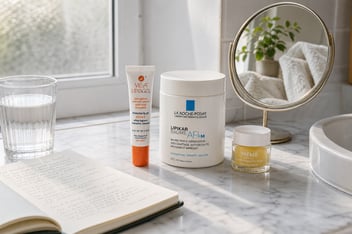
Sensitive skin: three gestures, three moments of truth
For people with sensitive skin, a product is first judged by what it does not do: it does not sting, it does not tighten, it does not leave a film. What is less known is that this rule is not checked at the same moment, or in the same way, depending on the gesture. A cleanser is judged at the rinse. A body cream is judged by the relief it brings, then by how soon you can get dressed. A face cream is judged in the mirror, over several days. We analysed more than 110,000 reviews from across Europe, with a close look at the UK, France and Germany. Fragrance makes the difference especially visible, just as a new EU rule on fragrance allergens starts to show on pack.
- "First, do no harm" holds everywhere. Across Europe, tolerance ranks among the top three choice drivers, and a heavy or greasy feel is the first barrier.
- But each gesture has its own moment of truth. Cleansers are judged at the rinse, body care at relief and when you get dressed, face care in the mirror over several days.
- Fragrance is welcome where it is rinsed off, unwanted where it stays. A subtle scent is a plus in a cleanser; on a leave-on cream, consumers expect neutrality.
- The new EU allergen rules point the same way. Since 31 July 2026, new products must declare 82 fragrance allergens, including 28 natural extracts, with a threshold ten times lower for leave-on products.
- For brands, the question becomes: which proof for which gesture, and which fragrance policy for which part of the range?
What we already knew: first, do no harm
In our Breast Cancer Awareness Month study, When taking care of yourself means something different, we saw that during and after cancer treatment, skincare is first judged by what it avoids: itching, tightness, burning. The deep dive When skin hurts added a second lesson: a reformulation can make people lose a trusted reference point.
The same rule appears, at a much larger scale, in sensitive-skin care across Europe. In the UK, France and Germany alike, hydration comes first among choice drivers and tolerance comes second or third. The vocabulary is negative: "didn't sting", "no tightness", "not greasy", "no scent". Consumers rarely name an active ingredient; they describe what did not happen.
So tolerance is the entry ticket. The more useful question for brands is where, and when, that ticket is checked.
- At the rinse: the cleanser. Nothing tightens, nothing stings.
- When getting dressed: body care. It soothes, then it disappears.
- In the mirror, over days: face care. Redness, stinging, makeup.
1. Body care: judged by relief, then by how soon you can get dressed
In the British reviews of body creams and emollients we analysed, relief comes first: hydration and the end of dry, itchy skin. Right behind it comes a very practical test: does it sink in fast enough to get dressed? A fast-absorbing, non-greasy finish is the second choice driver for body care in the UK.
The narrative is strong. Consumers describe products that "stopped the itching" and gave them back a normal life: sleeping, wearing clothes, not thinking about their skin all day. But the same reviews draw a clear line: a cream that soothes and stays sticky on clothes or sheets is a cream that gets moved to night-time, or dropped.
"Excellent product, soothing and effective whilst quickly and easily absorbed enabling clothing almost immediately."
Review of Epaderm Cream (body care), 5/5, UK.
The tension has a name in our analysis: rich protection versus light, fast absorption. Very dry skin needs richness; daily life does not tolerate a film.
In Germany, absorption comes first
In the German reviews of body care we analysed, the order is reversed: fast absorption without a greasy film is the first choice driver, ahead of moisturising. German reviews, where drugstore brands such as Mixa, Balea and Nivea weigh heavily, are especially direct about it: "zieht schnell ein", "klebt nicht", "kein Fettfilm".
„Sehr gute Salbe, zieht direkt in die Haut ein und fettet nicht.“
("Very good balm, absorbs straight into the skin and isn't greasy.")
Review of La Roche-Posay Lipikar Baume AP+M (body care), 5/5, Germany. Translated from German.
2. The cleanser: judged at the rinse
For cleansers, the order is the same in all three markets: tolerance comes first. The proof is felt within minutes, after rinsing: the skin does not tighten, does not itch, does not sting. Gentle cleansing "without post-wash dryness" is the language everywhere, from French cleansing oils to German shower gels.
Cleansers also carry their own trade-off: efficacy versus gentleness. A cleanser that foams little or leaves a light film can read as mild, or as not cleansing enough.
"It has a pleasant, unobtrusive scent and cleans the skin thoroughly without drying it out. […] no feeling of tightness at all."
Review of Balea MEN Waschgel Sensitive (cleanser), 5/5, Germany. Translated from German.
3. Face care: judged in the mirror, over several days
Face care is the least forgiving gesture. Consumers test a face cream for days or weeks and watch for redness, stinging, tightness, and how it behaves under makeup or around the eyes. In the UK face-care reviews we analysed, soothing and redness reduction come first, ahead of hydration. In Germany, tolerance comes first.
The same product can change role from one area to another: a body balm praised for relief is "too rich for the face", causing shine, pilling or breakouts.
« Immédiatement après l'application, je ressens une agréable sensation de soulagement […] Toutefois, à long terme, je ne constate pas de réduction significative des rougeurs. »
("Immediately after applying it, I feel a pleasant sense of relief […] However, in the long term, I don't see a significant reduction in redness.")
Review of Uriage Roséliane Anti-Redness Cream (face care), 4/5, France. Translated from French.
Top three choice drivers, by gesture and market
| United Kingdom | France | Germany | |
|---|---|---|---|
| Cleanser | 1. Tolerance 2. No post-wash dryness 3. Effective cleansing | 1. Gentle, no tightness 2. Softness after washing 3. Suits sensitive skin | 1. Tolerance 2. Effective cleansing 3. Comfortable skin feel |
| Body care | 1. Hydration, itch relief 2. Fast absorption 3. Suits eczema-prone skin | 1. Hydration 2. Itch relief 3. Fast absorption | 1. Fast absorption 2. Moisturising 3. Itch relief |
| Face care | 1. Soothing, redness 2. Hydration 3. Tolerance | 1. Hydration 2. Soothing, redness 3. Light texture | 1. Tolerance 2. Moisturising 3. Fast absorption |
Ranks of choice drivers mentioned in the reviews analysed, by gesture and market. Levels are not compared across countries.
Dermocosmetics – Sensitive Skin – Europe
Dermocosmetics · Europe · 114,000+ signals
Explore how people with sensitive skin judge cleansers, body care and face care: tolerance, relief, texture, fragrance and reformulations. Compare markets, gestures and brands.
4. Fragrance: where the three gestures part ways
Fragrance shows the difference between gestures most clearly. In cleansers, consumers describe what they want as "a pleasant but discreet scent, or no fragrance". In body and face care, the expectation becomes "fragrance-free, neutral".
The reviews say it plainly. In a shower gel, "a pleasant, unobtrusive scent" is a compliment. On a body cream, the absence of scent is the point:
"It is absorbed quickly, doesn't leave a greasy feeling […] No perfume so it doesn't interfere with the perfume that I am wearing."
Review of La Roche-Posay Lipikar Baume AP+M (body care), 5/5, UK.
"Fragrance-free" also works as a marker of satisfaction. English-language reviews that mention "fragrance free" are positive 93% of the time, against 85% for English-language reviews overall.
But "fragrance-free" is not enough on its own. It must also smell neutral. An unexpected base odour, described as "medicinal" or "like a hospital", is a barrier in its own right, especially in body care. And consumers do not equate "natural" with "fragrance-free": essential oils and scented botanicals are flagged as a risk by people with very reactive skin.
5. What 31 July 2026 changes
Since 31 July 2026, cosmetics newly placed on the EU market must declare 82 fragrance allergens on pack, up from 26. The list now includes 28 natural extracts, among them lavender, rose, citrus oils and peppermint. Products already on the market have until 31 July 2028. The declaration threshold is 0.001% for leave-on products, ten times lower than for rinse-off products (0.01%) (AGES; HPRA).
The rule and the consumer point the same way: both are stricter on what stays on the skin. Most of the reviews we analysed predate the new labels, so they cannot measure an effect. They do suggest three things to watch:
- Longer labels on leave-on products. Reviews show that sensitive-skin consumers read labels and repeat "free-from" claims. A longer allergen list could be read just as closely.
- Natural extracts made visible. Brands that rely on botanical scents may now display allergens on products that consumers see as gentle by nature.
- Compliance reformulations at a fragile moment. If brands reformulate to reduce declared allergens, they touch the moment when trust is most fragile. In all three languages we studied, most reviews that describe a new formula are negative: about eight in ten in French and German, seven in ten in English, against fewer than one in ten overall. The break hits dermocosmetic and mass-market brands alike.
"Used this moisturiser for 20 years then they changed it by adding niacinamide and now it pills under makeup so have switched to another brand."
Review of Simple Kind to Skin Replenishing Rich Moisturiser (face care), 1/5, UK.
"For decades I have only used Nivea Sensitive […] The new formula feels awful. A sticky film […]"
Review of NIVEA Care Creme Sensitive (body and face care), 1/5, Germany. Translated from German.
6. What this means for brands
The points below are Sensia's interpretation of the findings above.
| Team | What the reviews show | Questions to explore |
|---|---|---|
| Marketing and brand | Tolerance is expected; the winning proof depends on the gesture: after-rinse feel, relief and a finish you can dress over, calm skin in the mirror after several days | Which proof should lead the brief for each gesture in the range? |
| Strategy, category and portfolio | Scent carries pleasure in rinse-off products and becomes a risk on leave-on care, where the new labels are strictest | Where does fragrance belong in the range, and where should it go? Which reformulations are worth the risk of breaking a long-standing habit, and how should they be tested and announced? |
| Innovation and R&D | Two recurring briefs: rich textures that disappear, and neutral bases that do not need masking with fragrance | How rich can a texture be before it becomes a film? How neutral must a fragrance-free base smell? |
| Claims and scientific communication | Consumers speak in absences: "doesn't sting", "no tightness", "doesn't leave a film" | Do our claims use their language, and does the sensory experience confirm them? |
These questions apply beyond the brands in our analysis: they concern how the category is judged, not the performance of any single brand.
What we listened to
Scope: online consumer reviews from the Sensia space "Dermocosmetics – Sensitive Skin – Europe", covering sensitive-skin care (cleansers, body creams and emollients, face care, baby care) across Europe. More than 114,000 reviews from 183 product listings, including about 31,000 in France, 16,000 in the UK and 14,000 in Germany. Dermocosmetic brands lead in France and the UK; drugstore and mass brands lead in Germany.
Rankings: ranks and shares are calculated within the reviews analysed for each market and gesture; one review can cover several themes. Across countries and product types we compare ranks, not levels. Some UK sub-segments are concentrated on a few products; findings there are stated within the products studied. Reviews describing a reformulation were identified by semantic search in each language, then checked one by one.
Positivity bias: the average rating of the corpus is 4.7 out of 5. Irritants are friction signals, not incidence rates.
Quotes: excerpts from real, anonymous reviews, shortened where marked […] and translated where needed. Reviews from product-testing programmes are excluded.
External sources and scope: regulatory facts checked on 28 October 2026 against public authority sources. This article describes consumer experiences, not medical advice.
FAQ
Is this about atopic or eczema-prone skin?
Partly. Many reviewers describe very dry, reactive or eczema-prone skin in their own words. The findings describe their experiences of products, not a medical assessment.
Does the new allergen rule mean products will be reformulated?
Not necessarily. A brand can comply by extending its label. Reviews suggest that if a reformulation changes the feel, smell or texture, it can break trust with long-standing users.
Do these findings apply to brands outside the corpus?
They describe category expectations by gesture, not the performance of any brand. They can inform a brief, a range architecture or a claim, whatever the brand.
What about your brand?
The Sensia space "Dermocosmetics – Sensitive Skin – Europe" lets you take these findings further and compare expectations by brand, gesture and market. For example:
- Which tolerance proof do consumers expect for my cleanser, and for my body cream?
- Where in my range is fragrance welcome, and where does it become a barrier?
- What do reviews say after a reformulation in my category?
- How does my brand rank against the category on absorption, scent and soothing?
A broader question about your brand or range? Let's talk: our team can build a dedicated study.
Dermocosmetics – Sensitive Skin – Europe
Dermocosmetics · Europe · 114,000+ signals
Explore how people with sensitive skin judge cleansers, body care and face care: tolerance, relief, texture, fragrance and reformulations. Compare markets, gestures and brands.